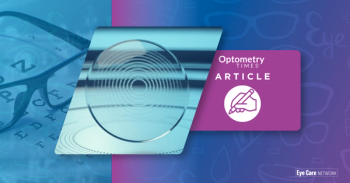
DOT lenses reduce retinal contrast signaling through embedded light-scattering elements while maintaining a single power across the lens, rather than creating peripheral defocus with multiple optical powers.
David Webley, BSc (Hons), MCOptom, FBCLA, weighs in on SightGlass Vision's latest data presented at AAOpt's annual meeting in Anaheim, California.
David Webley, BSc (Hons), MCOptom, FBCLA, senior director for clinical medical and professional affairs at SightGlass Vision, discusses 2 studies presented at the American Academy of Optometry (AAOpt) Annual Meeting in Anaheim, California. Both studies examined how children use myopia-management spectacles with DOT lenses, comparing their visual and behavioral responses with those of children wearing standard single-vision lenses.
The first study, "Assessment of Viewing Behavior with Contrast Modulation Myopia Control Spectacle Lenses,” was conducted with Indiana University and looked at children’s behavior during 4 activities: reading, gaming, classroom tasks, and walking. Across these tasks, researchers found no difference in viewing behavior or head position between children wearing dot lenses and those wearing single-vision lenses. The findings suggest children did not need to compensate for the DOT lenses or change how they looked through their spectacles while carrying out everyday activities. The study also compared younger and older children. Lens type did not affect viewing behavior in either age group, while differences between the age groups were more noticeable than differences between lens types.
The second study, “Immersive Motion Capture Evaluation of Contrast Modulation Spectacle Lenses for Myopia Control in Children,” was conducted with Midwestern University and assessed children in simulated activities, including detecting obstacles while riding a bicycle, catching a baseball, and locating and fixating on objects in their surroundings. Researchers found no significant differences between children wearing dot lenses and those wearing single-vision lenses in these scenarios either.
Webley explains that the research focused on whether the treatment design on the lenses might influence how children wear their spectacles or use their gaze. He places these studies alongside previous investigations indicating that visual function with DOT lenses is comparable to that with standard single-vision lenses. The results described in the interview add evidence that children’s viewing and navigation behaviors remain similar across a range of activities.
The practical takeaway is that practitioners do not need to instruct children to alter their behavior when prescribing dot lenses. Children can continue to wear and use the spectacles as they would standard single-vision glasses. Webley’s broader point is that myopia-management spectacles should be evaluated not only for their ability to control myopia, but also for how well they correct vision and support children’s visual function in daily life. The studies discussed suggest that, for the activities tested, dot lenses did not meaningfully change children’s viewing behavior compared with single-vision lenses.