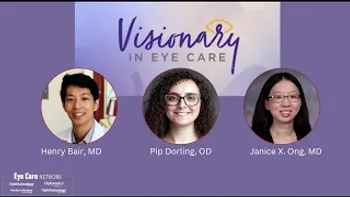
Three residents were honored for their leadership, education and research, and patient care contributions in ophthalmology, optometry, and retina.
Andrew Pucker, OD, PhD, FAAO, FSLS, FBCLA, discussed how oculomics research presented at AAOpt 2026 could eventually support point-of-care diagnosis and referral decisions.
Andrew Pucker, OD, PhD, FAAO, FSLS, FBCLA, moderated this year's Monroe Hirsch Symposium at AAOpt 2026, which focused on oculomics. Pucker is a member of the AAO’s research committee, which organizes the annual memorial lecture series on emerging technologies in the field of optometry. He stopped by to give an overview of the key takeaways from the symposium.
The symposium, titled "Oculomics – Leveraging Ocular Biomarkers to Assess Systemic Health," featured 3 speakers.¹ Vivek Srinivasan, PhD, started the session with a discussion on visible light optical coherence tomography (OCT), which provides more detailed retinal imaging than near-infrared OCT. Srinivasan conducts research at the NYU Langone Health, where his group studies retinal markers that contribute to AMD progression and neurodegeneration.
Douglas Borchman, PhD, presented his work using advanced methods to study tear lipidomics. According to Pucker, Borchman identified patterns in tear samples that distinguished individuals with dry eye from those without it.
The third speaker, Nawajes Mandal, MSc, Phd, discussed his research examining sphingolipid signaling and biomarkers. Mandal’s work identifies bioactive sphingolipids that are regulators of various eye conditions, such as retinal degeneration and corneal disease.
“Some of this is very innovative and new, and it’s not quite ready for clinic. But, this basic research will help us get to diagnostic tests that hopefully will…allow us to be able to have a point-of-care test, such as maybe…an MMP-9 test for understanding these different conditions,” Pucker stated.
Pucker, whose research interests include dry eye, stated that a lack of correlation between signs and symptoms makes the condition difficult to diagnose and treat. He pointed out that knowledge on biomarkers can help optometrists implement early intervention strategies for better patient outcomes.
Pucker suggested that machine learning could allow a diagnostic test to assess several markers at once. An AI system could then detect an overall pattern indicating whether a patient has dry eye. Additionally, a fundamental understanding of oculomics could help clinicians identify patients sooner, begin treatment earlier, and reduce progression to advanced disease that is harder to treat.
“We are the first to detect different conditions, and what I think oculomics could help us do is better understand when it's time to potentially refer to ophthalmology,” Pucker stated. He also suggested that oculomics could reduce guesswork for optometrists.
Pucker encouraged clinicians to continue to attend the symposium at annual AAOpt meetings.