
Commentary|Videos|November 4, 2026
The Independent Advantage S02 E09: Where practices lose patients
According to Raphael Rostenne, CTO of EyeCarePro, "anything that takes time" has the potential to frustrate patients, especially before they're in a practitioner's chair.
Advertisement
In the latest episode of The Independent Advantage, host Diana-Canto-Sims, OD, speaks with Raphael Rostenne from EyeCarePro about what makes an exceptional patient experience, where eye-care practices may lose prospective patients, and how AI voice agents can support front-desk operations.
Rostenne says delays and friction are major sources of patient frustration. A caller may become annoyed by a ringing phone, an IVR menu, irrelevant automated prompts, having to press buttons, and waiting again to reach a person. The experience can worsen if the staff member who answers gives only a very brief, unhelpful response. Canto-Sims agrees that practices may underestimate how frustrating their phone systems can be and frames the discussion as a reminder to pay closer attention to how calls are handled.
Episodes in this series


Rostenne and Canto-Sims identify questions about pricing, insurance, and appointment availability as common points where practices can unintentionally lose new patients. Rostenne advises against simply telling someone that their insurance is out of network. Instead, practices can explain possible options, discuss assistance with out-of-network benefits, or communicate the value of choosing the practice anyway. Availability also matters: practices may have open appointment slots but struggle to fill them.
On the role of AI, Rostenne says voice agents are best suited to routine, clearly defined tasks. Examples include answering frequently asked questions about pricing, office hours, locations, directions, and accepted insurance plans, as well as handling routine booking, cancellation, and rescheduling requests. Practices can provide their own FAQs, and Raphael emphasizes that answers should be useful and complete. More complex service questions and medical emergencies should be handled by people, not the voice agent. Callers can also request a representative; Rostenne says that happens immediately in roughly 50–60% of calls to their agent, with callers routed to the practice when it is open.
The discussion also addresses concerns about liability, HIPAA, and patient privacy. Rostenne recommends choosing a trusted technology partner, putting a HIPAA agreement in place, and testing the system before expanding its use. He describes the voice agent as a voice-based way to access online scheduling, using the practice’s scheduler behind the scenes and connecting to it in the same secure way as online booking.
The episode closes with Canto-Sims introducing a forthcoming episode for Wednesday, November 11 about what happens behind the scenes when an AI voice agent answers a call.
Subscribe to Independent Advantage’s
Advertisement
Related to this article
Raphael Rostenne discusses what a good phone call looks like and contributes to successful patient interactions with host Diana Canto-Sims, OD.
Diana Canto-Sims, OD, introduces the second guest of Season 2, Raphael Rostenne, who will be discussing AI-assisted front desk management.
For Maria Sampalis, OD, implementing AI isn't an excuse for practice owners to replace their staff with new technology; it should instead lift the burden of certain tasks to make for more patient visits.

Kansas, Tennessee, and Vermont expanded optometric scope in 2026, while vision plan reform and a proposed Medicare fee schedule cut affect practice management.
This week’s top stories include pipeline updates in dry eye, retinitis pigmentosa, contact lens hygiene, and more.

This week's top stories include breaking FDA approvals, insights on AI-assisted front desk management, and more.

Now on EYE7 smart glasses, Eva goes beyond answering questions by reasoning about user needs and controlling vision-enhancement features.
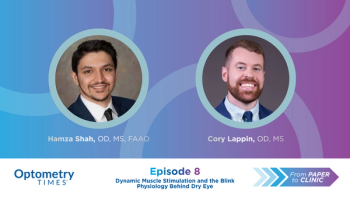
Host Hamza Shah, OD, MS, FAAO, is joined by Melissa Barnett, OD, FAAO, FSLS, FBCLA, to discuss burnout among US optometrists, inspired by Abbott et al's nationwide survey.
Advertisement
Advertisement
Trending on Optometry Times - Clinical News & Expert Optometrist Insights
1
2026 legislative roundup: Scope, vision plans, and Medicare pay
2
The untapped partnership between retinal specialists and optometrists in myopia care
3
More magic in Anaheim: Highlights from AAOpt 2026
4
Eyedaptic releases AI assistant Eva for patients with retinal disease
5