
Commentary|Videos|October 21, 2026
The Independent Advantage S02 E07: Is your front desk missing opportunities?
Diana Canto-Sims, OD, introduces the second guest of Season 2, Raphael Rostenne, who will be discussing AI-assisted front desk management.
Advertisement
For Episode 7 of The Independent Advantage’s Season 2, Diana Canto-Sims, OD, introduces a new artificial intelligence-informed discussion with a new guest. She opens the conversation by identifying phone access as a major operational challenge for independent optometry practices. Although practices invest in websites, online scheduling, digital marketing, and social media, the phone remains an important way for new and established patients to connect and book appointments. Canto-Sims’s guest, Raphael Rostenne, chief technology officer of EyeCarePro, brings experience in user experience and technology, along with data gathered from patient communications across optometry practices.
Episodes in this series


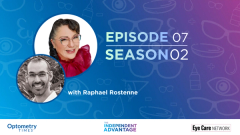
Rostenne says patient expectations have changed over the past 5 years: people have less patience and often want convenient, immediate service. Online scheduling does meet some of that demand, and his organization operates online schedulers for more than 200 practices. However, data from those schedulers and phone calls—recorded and analyzed across more than 400 practices, with about 180,000 calls a month—suggests that the phone is still the leading booking channel. At a typical practice, about 50% more appointments are booked by phone than through the online scheduler. Patients may want to speak with someone and ask questions, especially when making a health-related appointment.
The discussion then turns to why practices miss calls. Front-office staff are often juggling in-person patients, incoming calls, and other responsibilities, and staffing shortages can make the problem worse. Rostenne emphasizes that missed calls are not necessarily a reflection of staff effort: he says the loss often begins before a staff member has a chance to answer. His analysis suggests that around 30% of calls are missed, and about 80% of those missed calls occur during the interactive voice response (IVR) stage. Long menus, lengthy instructions, and information callers do not need can prompt impatient people to hang up before reaching the office.
Rostenne identifies shortening the IVR as the most effective first step for recovering opportunities lost through missed calls. Calls can also be lost while callers wait for someone to answer, outside business hours, or during a long voicemail greeting. Many callers do not leave a message. When a patient cannot get through, Rostenne says, they may call another practice rather than try again.
Canto-Sims adds that patients may decide late at night that they need an eye exam or help with symptoms, so practices need ways to respond when staff are unavailable. The episode closes by previewing what will be discussed in the next episode, which includes about what surprised Rostenne most while analyzing patient communication data.
Subscribe to Independent Advantage’s
Advertisement
Related to this article
For Maria Sampalis, OD, implementing AI isn't an excuse for practice owners to replace their staff with new technology; it should instead lift the burden of certain tasks to make for more patient visits.
Maria Sampalis, OD, discusses her implementation of the EHR software Barti in her practice.

IDOC's 2025 benchmarks from 175-plus independent OD practices put median practice net at 31% of revenue as variable costs fell for the first time since tracking began.
Andrew Pucker, OD, PhD, FAAO, FSLS, FBCLA, discussed how oculomics research presented at AAOpt 2026 could eventually support point-of-care diagnosis and referral decisions.

From dry eye to GLP-1s, this year's conference brought a variety of insights from key experts in optometry.
Susan Gromacki, OD, MS, FAAO, FSLS, details one of her AAOpt 2026 sessions, titled "Advances in Contact Lens Care for the New Contact Lens Technologies."
Presenters from AAOpt26's research symposium share their findings, applications for optometric practice, and goals for future study.
Walline, American Academy of Optometry president, shares this year's conference attendance numbers, clinical pearls, and what he hopes to see in 2027.
Advertisement
Advertisement
Trending on Optometry Times - Clinical News & Expert Optometrist Insights
1
FDA approves Brytly eye drops for ocular redness relief lasting up to 12 hours
2
FDA approves phentolamine ophthalmic solution 0.75% (Ryzumvi) for presbyopia
3
Duravyu for wet AMD misses primary end point in phase 3 LUCIA trial
4
FDA approves subcutaneous Enspryng for TED
5