
Commentary|Videos|October 7, 2026
The Independent Advantage S02 E05: AI and EMR/EHR systems
Maria Sampalis, OD, discusses her implementation of the EHR software Barti in her practice.
Advertisement
The latest episode of The Independent Advantage focuses on a real-world example of implementing AI within an optometry practice, using Barti (an eye-care–specific EHR/EMR system with integrated AI tools) as the reference platform. Diana Canto-Sims, OD, asks Dr. Maria Sampalis, OD to describe the practice challenges that led her to adopt Barti and how it has impacted workflow and staffing.
Sampalis explains that her previous system, DoctorChrono, was not truly built for eye care and lacked integration between the clinical and optical sides. This resulted in significant double data entry, inefficiencies, and a higher risk of errors, especially with new staff. Migrating to Barti involved a learning curve, but the data transfer support was strong. She notes that staffing issues—rather than AI itself—have been the main recent challenge, and that AI is being used to relieve pressure rather than to replace staff. All staff are cross-trained, and her intention is to offload repetitive tasks, reduce training-related errors (such as incorrect segment heights or product selection), and improve accuracy with coding and billing.
Episodes in this series


A key benefit she highlights is improved workflow, especially in charting. Barti’s AI scribe summarizes the patient conversation in real time and populates the chart, streamlining documentation. Scheduling has also improved: patients can book online, including after hours, which helps fill the schedule. Integrated text messaging allows patients to make or reschedule appointments, further reducing front desk workload. She gives practical examples such as online contact lens ordering, which avoids phone delays, miscommunications, and costly product errors.
Sampalis believes a wide range of practices—from cold starts to multi-location and corporate sublease practices—can benefit from a system like Barti, particularly when staff are limited but patient volume is high. AI can support pretesting, insurance checks, and call handling, and may reduce the need for large call centers while enabling staff to focus on revenue-generating and educational interactions (eg, multiple pairs, IPL, glasses, contacts).
Sampalis notes that very “old-school” practices, especially those still relying heavily on paper or traditional landlines and resistant to technology change, may find this a difficult first investment, particularly where VoIP or integrated phone-based AI is required. Overall, she frames Barti as a newer, eye-care–specific platform designed around common pain points—fewer clicks, embedded AI, and native integration—rather than a bolted-on AI layer to older systems.
Advertisement
Related to this article
Maria Sampalis, OD, tells Diana Canto-Sims, OD, in this week's episode that the biggest impact AI has made at her practice is when used in the exam room as a scribe for routine patients.
To kick off Perimenopause and Menopause Awareness Month, Meredith Bishop, OD, MS, FAAO, gives an overview of her poster "Perceptions of Linking Presbyopia with Perimenopause: A Survey of US Female Eye Care Professionals."
Magdalena Stec, OD, FAAO, and Noreen Shaikh, OD, MEd, FAAO, gave an overview of current evidence-based myopia control treatments in part of their AAOpt 2026 session.
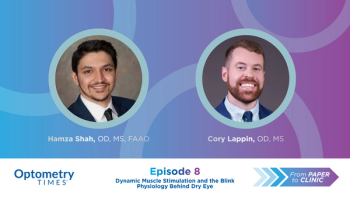
Host Hamza Shah, OD, MS, FAAO, is joined by Cory Lappin, OD, MS, FAAO, to discuss dynamic muscle stimulation for dry eye, spurred by a paper on improving blinking in dry eye patients.
Sherrol Reynolds, OD, FAAO, details her session "GLP-1RAs and Ocular Health: AOA Guidance for Optometric Practice 2025" during AAOpt 2026.
Nora Lee Cothran, OD, FAAO, reviews a study which found a statistically significant reduction in IOP in patients with open-angle glaucoma and ocular hypertension when switching to latanoprostene bunod.
Jade Coats, OD, FAAO, stopped by to discuss her presentation at AAOpt 2026, titled"How Eyelid Hygiene Can Change the Dry Eye Conversation."
Neda Gioia, OD, CNS, FMCP, FOWNS, CFMP, details a lack of research exploring the intersection of hormones and ocular health in women and what health care as a whole should investigate next.
Advertisement
Advertisement
Trending on Optometry Times - Clinical News & Expert Optometrist Insights
1
AAOpt 2026: Photobiomodulation to revolutionize dry AMD treatment, Dr Rafieetary says
2
AAOpt 2026: Demodex tied to worse MGD as dry eye questionnaires miss blepharitis
3
AAOpt 2026: Managing complex pediatric myopia cases
4
AAOpt 2026: Aflibercept 8 mg extends RVO dosing as Amsler misses AMD damage
5