
News|Videos|April 29, 2026
The Independent Advantage S01 E04: Changing comanagement culture
Giannie Castellanos, OD, calls on optometrists to empower others in the field and refer within their specialty.
Advertisement
Episodes in this series
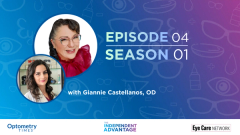
This episode of The Independent Advantage episode centers on how to make true collaborative care between optometrists (ODs) and ophthalmologists (MDs) the norm rather than the exception. Giannie Castellanos, OD, drawing primarily from experience in Florida, explained that optometry–ophthalmology collaboration is significantly behind where it should be, despite it being a major personal passion and professional goal.
Diana Canto-Sims, OD, and Castellanos describe an ideal synergistic relationship where both professions co-manage patients as a unified team. A key element of this relationship is operational simplicity for doctors: having a referral portal or dedicated referral coordinator who tracks patients from initial referral through to completion of care. Castellanos highlighted one exemplary practice where the referral coordinator emails every time a patient fails to schedule, asks whether co-management is desired, sends referrals back, and even collaborates on staffing needs. This kind of reciprocity—referring to each other, sharing candidates, and co-managing—is presented as the model to strive for.
Culturally, however, there are barriers. Castellanos noted that optometrists often feel overshadowed by ophthalmology, with pediatric cases, scleral lenses, and specialty contacts frequently routed to ophthalmology practices, even when an OD might be better suited. She argued that optometrists must first empower and refer within their own profession, directing patients to colleagues who specialize in areas like dry eye, IPL, or vision therapy, and then building relationships with ophthalmologists who are ethical, patient-centered, have time to co-manage, and possess strong referral coordination systems.
Another major theme is systems and technology. Canto-Sims and Castellanos lament limitations in EMRs and practice management systems, which make it difficult to send notes, integrate with ophthalmology systems, and seamlessly track referrals. They emphasized the importance—and current lack—of robust referral tracking mechanisms, noting that without them, many patients are lost after surgery or specialist visits and never return for ongoing care such as glasses or follow-up exams. While simple tools like Google Docs are suggested conceptually, concerns about HIPAA compliance and data security make many free or informal platforms unsuitable. The discussion closes by stressing that optometry must improve both its cultural mindset and its handling of patient privacy and secure communication if it wants to build stronger, sustainable OD–MD referral relationships.
Advertisement
Related Content



Latest CME


Advertisement
Advertisement
Trending on Optometry Times - Clinical News & Expert Optometrist Insights
1
UI researchers to advance potential antioxidant eye treatment with NIH funding award
2
Managing MIGS: An optometrist’s practical comanagement guide
3
Takeaways from this week in optometry: September 7-11
4
FDA accepts Nanoscope's BLA for MCO-010 in retinitis pigmentosa
5