
A single Epioxa epi-on cross-linking treatment sustained a 1.9 D Kmax improvement through three years in keratoconus, with no serious adverse events reported.

Matt Hoffman is the editorial director for the Eye Care Network (Ophthalmology Times, Modern Retina, Ophthalmology Times Europe, and Optometry Times) as well as NeurologyLive, Contagion, IJMSC, and CGTLive. He has covered medical news for MJH Life Sciences, the parent company, since 2017.
He executive produces the Optometry Times podcast, From Paper to Clinic, and previously hosted the Medical World News shows Deep Dive and Second Opinion.
You can follow him on X @byMattHoffman and on LinkedIn, or email him at mhoffman@mjhlifesciences.com.
A single Epioxa epi-on cross-linking treatment sustained a 1.9 D Kmax improvement through three years in keratoconus, with no serious adverse events reported.

IDOC's 2025 benchmarks from 175-plus independent OD practices put median practice net at 31% of revenue as variable costs fell for the first time since tracking began.
Aflibercept 8 mg cut RVO injections by up to 3 over 64 weeks in QUASAR, while a pair of additional posters show Amsler gaps in AMD and BRAO-linked stroke risk.
Host Hamza Shah, OD, MS, FAAO, is joined by Cory Lappin, OD, MS, FAAO, to discuss dynamic muscle stimulation for dry eye, spurred by a paper on improving blinking in dry eye patients.

A pair of cases from Academy 2026 show scleral lens refits for severe keratoconus, one addressing focal corneal edema and one fitting around glaucoma tube shunts.
Dry eye questionnaires capture only 22.4% of Demodex blepharitis symptoms, and a 22-study review links Demodex infestation to worse meibomian gland function.
Real-world PFHO data show OSDI scores falling within 2 weeks, while a 12-month trial finds stable corneal endothelial cell density with cyclosporine 0.1%.

Sharon Fekrat, MD, FACS, FASRS, of Duke University, discusses how retinal imaging fits into the diagnostic picture for CVI, TBI, and neurodegenerative disease, and when eye care professionals should suspect a neurological cause.
Host Hamza Shah, OD, MS, FAAO, is joined by Leonard Messner, OD, to discuss GLP-1s and idiopathic intracranial hypertension, inspired by Mitchell et al's paper, "The Effect of GLP-1RA Exenatide on Idiopathic Intracranial Hypertension: A Randomized Clinical Trial."

The company announced phase 2 results of a dual-action lifitegrast/perfluorohexyloctane dry eye drop alongside positive phase 1b results for BL1332, a first-in-class TRPV1 antagonist for ocular surface pain.

The FDA has expanded the indication to include improvement of meibomian gland function in adult patients with evaporative dry eye disease due to MGD, making it the first treatment with this indication.
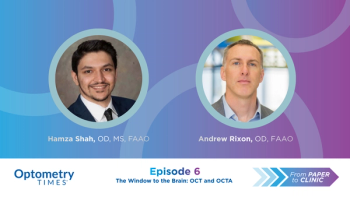
Host Hamza Shah, OD, MS, FAAO, is joined by Andrew Rixon, OD, FAAO, to discuss OCT and OCTA's utility in identifying neurogeneration, inspired by Lepoittevin et al's paper "Retinal Biomarkers for Early Alzheimer's Detection: A Systematic Review of Optical Coherence Tomography (OCT) Findings."
Jade Coats, OD, FAAO, stated that providing pre- and post-op patient care can provide an opportunity to support ophthalmologists.
Jessica Steen, OD, FAAO, DipABO, stated that each ADC can have distinct ophthalmic monitoring needs and management protocols.
Neda Gioia, OD, CNS, FMCP, FOWNS, CFMP, stated that preparing optometric students for the possibility of burnout may help reduce its prevalence.
Erin Rueff, OD, PhD, FAAO, provides tips to fellow clinicians on how to keep these patients comfortable in their lenses.
Jade Coats, OD, FAAO, details what has changed in dry eye treatment in the last decade, and how to optimize the ocular surface through the power of comanagement.
Jessica Steen, OD, FAAO, DipABO, weighs in on what the optometric community should know concerning what side effects their patients may experience.
Host Hamza Shah, OD, MS, FAAO, is joined by Brianna Rhue, OD, FAAO, to discuss eye care terminology, inspired by Zhang et al's paper, "Myopia Progression Management: Current Trends and Future Directions."
Jessilin Quint, OD, MBA, FAAO, said that integrating AI into your practice can start small.
Neda Gioia, OD, CNS, FMCP, FOWNS, CFMP, details what she finds concerning and surprising in a recent study she conducted with Kaleb Abbott, OD, MS, FAAO, FOWNS.
Erin Rueff, OD, PhD, FAAO, provides an introduction to Johnson & Johnson's versatile contact lens family.
Mark Schaeffer, OD, FAAO, stated that optometrists should be prepared for even the rarest cases of emergencies and urgencies.
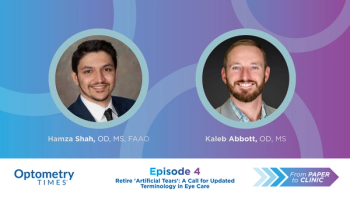
Host Hamza Shah, OD, MS, FAAO, is joined by Kaleb Abbott, OD, MS, to discuss eye care terminology, inspired by Abbott and Pucker's paper, "It's time to retire the terms artificial tears and rewetting drops: A call for accurate terminology and updated clinical usage in eye care."

The FDA's OND found substantial evidence of effectiveness for bevacizumab-vikg in nAMD, clearing the way for a BLA resubmission in June 2026 and a decision expected within 60 days.
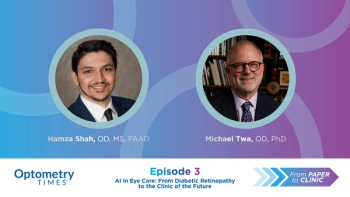
Host Hamza Shah, OD, MS, FAAO, is joined by Michael Twa, OD, PhD, to discuss artificial intelligence, inspired by Paredes et al's paper, "A Review of Recent Developments in Artificial Intelligence and Big Data Technologies for Ophthalmology Referrals and Clinical Practice."
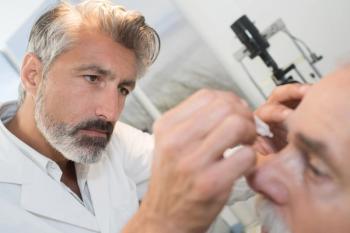
Several presentations at ASCRS 2026 spotlight faster dry eye relief and smarter pre-operative care, showing lifitegrast and new drugs can ease symptoms quickly and improve cataract biometry.
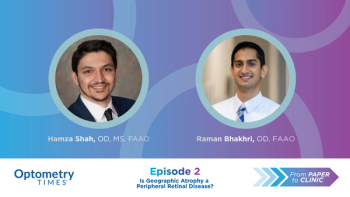
Host Hamza Shah, OD, MS, FAAO, is joined by Raman Bhakhri, OD, FAAO, to discuss geographic atrophy, spurred by Del Priore's paper, "Is geographic atrophy a peripheral retinal disease?"
Explore why near work—not just screens—drives kids’ myopia risk, while silent dry eye worsens early; learn practical habits to boost prevention and compliance.
New GA therapies and photobiomodulation push optometrists to refer dry AMD earlier, counsel smoking cessation, and sharpen retinal care for diabetes.
July 15th 2026