
Click the links below to subscribe to the show on your favorite platform and get notified with each new episode:
Commentary|Podcasts|August 3, 2026
From Paper to Clinic, Episode 6: The Window to the Brain: OCT and OCTA
Fact checked by: Kirsty Mackay
Host Hamza Shah, OD, MS, FAAO, is joined by Andrew Rixon, OD, FAAO, to discuss OCT and OCTA's utility in identifying neurogeneration, inspired by Lepoittevin et al's paper "Retinal Biomarkers for Early Alzheimer's Detection: A Systematic Review of Optical Coherence Tomography (OCT) Findings."
Advertisement
Welcome to From Paper to Clinic, a podcast focused on evidence-based eye care and real-world clinical decision-making, hosted by Hamza Shah, OD, MS, FAAO, a faculty member at the University of Houston College of Optometry. His work spans clinical patient care, education, and mentoring, and his clinical interests include ocular disease, dry eye, perioperative care, and, above all, the challenge of translating information into meaningful patient outcomes.
In Episode 6 of From Paper to Clinic, “The Window to the Brain: OCT and OCTA,” host Hamza Shah, OD, sits down with Andrew Rixon, OD, FAAO, to discuss a systematic review on retinal biomarkers for the detection of early Alzheimer disease and what it means for everyday optometric care. Rixon starts by clearing up our language regarding dementia as a broad clinical syndrome vs Alzheimer disease as a specific pathologic subtype characterized by beta-amyloid deposition and phosphorylated tau. From there, the pair explores why catching patients at the preclinical or very early symptomatic stage matters, when biomarkers may be detectable 10 to 15 years before overt decline, but current therapies remain only modestly effective. This naturally leads to the idea of the “retina as a window to the brain.” Shah and Rixon walk through the shared neuroectodermal origin of the retina and the central nervous system, parallels in vascular and barrier systems, and emerging data showing amyloid and tau in ocular tissues, including retinal ganglion cells and even the aqueous humor, at levels comparable to CSF.
The discussion then shifts from theory to optical coherence tomography (OCT) and OCT angiography (OCTA) at the slit lamp. Shah and Rickson review the paper’s heterogeneous OCT/OCTA findings—some studies show thickening and increased vascular density, others thinning and rarefaction—and explain how early inflammatory or vascular changes could precede later neurodegeneration, making simple “thick vs thin” heuristics unreliable in isolation. Rickson outlines how OCTA actually works in the clinic, why it does not replace dye-based angiography, and where it shines today: detecting quiescent, nonexudative macular neovascular membranes in age-related macular degeneration and complementing ultra-widefield imaging rather than supplanting it. They also touch on the still-evolving role of OCTA in glaucoma—particularly in suspected normal-tension glaucoma phenotypes—while underscoring the current lack of robust normative vessel-density databases. Throughout, Shah pushes the conversation toward what clinicians can do now: use OCT/OCTA judiciously rather than reflexively, avoid overpromising on Alzheimer “screening” from a single scan, and prepare for a future where higher-resolution imaging and artificial intelligence may finally bring that sci-fi–style, noninvasive neurodegeneration assessment closer to reality.
The paper inspiring this discussion is "
Do you want to only listen to this episode? Check out the audio player below.
Episode 7 is coming on Monday, September 7, 2026, at 8 AM ET
The seventh episode of From Paper to Clinic debuts in early September and features Leonard Messner, OD, who focuses on the effect of the glucagon-like peptide 1 receptor agonist exenatide on idiopathic intracranial hypertension. Listeners are invited to join the conversation as the series explores how evidence moves––from paper to clinic.
Advertisement
Related to this article
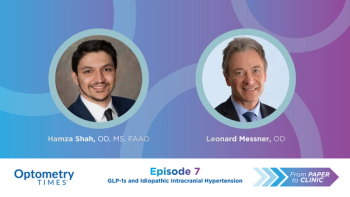
Host Hamza Shah, OD, MS, FAAO, is joined by Leonard Messner, OD, to discuss GLP-1s and idiopathic intracranial hypertension, inspired by Mitchell et al's paper, "The Effect of GLP-1RA Exenatide on Idiopathic Intracranial Hypertension: A Randomized Clinical Trial."
Vision testing results from 384 public transport drivers in Mumbai found the Visiolite 4K screener accurately matched standard assessments while cutting screening time by 65%.
Jem Martin, OD, discusses the accommodations and referrals any provider can offer, the red flags that should raise suspicion of CVI, and how the free TEACHCVI screening tool works in practice.
Optometrists should know what is expected, what is concerning, and when to contact the surgeon.
Heru's PretestPro runs 4 pretesting exams in about 90 seconds on the Heru Prime wearable platform and reaches all current and future customers via free software update.

The latest in drug and technology developments and updates from August 2026.
Merabet, OD, PhD, MPH, discusses what his research on motion processing reveals about the neural roots of CVI and where diagnostic tools like neuroimaging and eye tracking are headed.
Catch up on the top stories in optometry during the week of August 31-September 4.
Advertisement
Advertisement
Trending on Optometry Times - Clinical News & Expert Optometrist Insights
1
Portable vision screener provides accurate clinical assessment for drivers, study finds
2
The Independent Advantage S02 E02: Should you worry about AI replacing you?
3
Study: Adolescents with migraines associated with binocular vision difficulties
4
AMA passes resolution backing formal disease classification for myopia
5