Now Playing
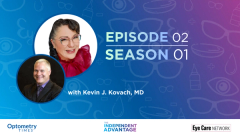
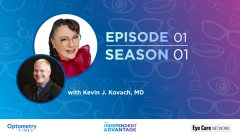
Diana Canto-Sims, OD, kicks off her interview series with a conversation with Kevin J. Kovach, MD, on comanagement.
In her debut episode for her interview series The Independent Advantage, Diana Canto-Sims, OD, owner and founder of Buena Vista Optical in Chicago, Illinois, opened by explaining that one of the most important decisions an optometrist makes is choosing an ophthalmologist they can truly trust with their patients. She emphasized that optometrists invest heavily in building patient trust, and that trust can either be honored or broken the moment a referral is made. The purpose of the session is 2-fold: (1) how to find an ophthalmologist you can trust, and (2) how to make referrals so strong that both the patient and the ophthalmology partner feel supported.
She introduced Kevin J. Kovach, MD, a board‑certified comprehensive ophthalmologist with over 30 years of clinical and surgical experience in the Chicagoland area. He is the founder and medical director of Kovach Eye Institute and owner of the Ophthalmology Surgery Center of Illinois, with expertise in cataracts, glaucoma, refractive surgery, and complex eye conditions. He is recognized as an early adopter of advanced procedures, such as small incision lenticule extraction and implantable collamer lens surgery, bringing cutting‑edge vision correction options to Illinois patients.
When Canto-Sims asked what questions ODs should ask ophthalmologists when first forming a relationship, Kovach stressed quality of results, patient experience, and adaptability to technology as key benchmarks. He explained that optometrists need reassurance that their patients will return to them after surgery or specialty care. Signs of a good partner include clear day 1 communication, agreement on when care transfers back to the OD, and structured methods of sharing clinical notes, such as portals, Health Insurance Portability and Accountability Act–compliant faxes, or emails.
Regarding comanagement, he suggested that optometrists interview and even observe the ophthalmologist in surgery or clinic to understand how they practice and to clearly communicate expectations. He noted that ODs vary in their comfort level with tasks on postoperative day 1, for example, and it is the ophthalmologist’s responsibility to respect those boundaries and support them.
To evaluate or strengthen an existing referral relationship, Kovach recommends first speaking with colleagues to gather feedback on specific ophthalmologists. He underscores that personal rapport, trust, and organized communication are non‑negotiable. Canto-Sims shares experiences with ophthalmologists who either approached too superficially (dropping off business cards without a real conversation) or failed to follow through on referrals, illustrating how relationships can falter without sustained communication.
Kovach explains that his own practice uses a team of liaisons and patient education coordinators to maintain regular, structured contact with referring optometrists—communicating what was done, when, and what follow‑up is needed. He concludes that if an ophthalmologist does not provide direct contact information or a systematic communication channel, patient care will ultimately suffer. Thus, reliable communication, clear expectations, and mutual respect are portrayed as the foundations of a successful OD-MD partnership.