
Commentary|Videos|September 23, 2026
The Independent Advantage S02 E03: Utilizing AI for efficiency in staff workflow
Maria Sampalis, OD, is an advocate for getting artificial intelligence to do tasks that provide more time to spend with patients, such as letter-writing.
Advertisement
This episode of The Independent Advantage, hosted by Diana Canto-Sims, OD, focuses on how AI is reshaping daily workflows in optometric practice without replacing optometrists themselves. Instead of taking over clinical decision-making, AI is framed as handling the administrative, repetitive, and time-consuming tasks that most clinicians and staff dislike.
The discussion opens with the question, “If AI isn’t replacing optometrists, what exactly is it replacing?” Maria Sampalis, OD, explains that AI is best used for charting, documentation, appointment management, billing support, and error detection. She notes that insurers already use AI to generate denials, and suggests practices should leverage similar tools to reduce audits and catch billing issues proactively.
Episodes in this series


From the perspective of younger ODs, Sampalis highlights that many are hesitant to own practices due to staffing headaches and operational burdens. AI is presented as a way to lower that barrier by taking on prior authorizations, letters, and patient communications, thereby making practice ownership or employment more sustainable.
Sampalis describes her own “entry point” with AI: tackling repetitive documentation and written communication. She frequently uses AI tools (including ChatGPT) to refine grammar, adjust tone, and streamline emails, social posts, e-blasts, and prior authorization letters. A key benefit is the ability to maintain a warm, patient-friendly tone in holiday and appreciation letters while saving time on drafting and editing.
Sampalis also emphasizes AI’s growing role in clinical support, including image review for second opinions, glaucoma monitoring, and trend analysis on OCT data, which is already widely used. AI flags changes and progression, prompting closer review rather than replacing clinical judgment.
The main impact on the Sampalis team’s workflow is summarized in three themes: efficiency, reduced front desk pressure, and more time for patient interaction. By automating routine tasks and phone-related workload, staff can focus on conversation, relationship-building, and better customer service, rather than rushing through encounters. The episode closes with a teaser that the next segment will explore lessons learned from implementing AI in practice.
Advertisement
Related to this article
In the latest episode of The Independent Advantage, Maria Sampalis, OD, gives a resounding "absolutely not" when posited with the question of whether or not eye care providers will be replaced by AI.
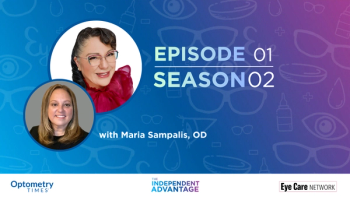
In the first episode of the second season of The Independent Advantage, Diana Canto-Sims, OD, chats with practice owner Maria Sampalis, OD, on why artificial intelligence has boomed in practice ownership spaces.
A comparison of ETDRS charts using Latin letters, Tumbling E, and Landolt C optotypes found the alternatives are comparable to letter acuity at the population level.
Jem Martin, OD, discusses the accommodations and referrals any provider can offer, the red flags that should raise suspicion of CVI, and how the free TEACHCVI screening tool works in practice.
Optometrists share advice on the best practices for ensuring students are prepared for the new school year and how clinicians can leverage the influx to grow their practice.
Roman-Lantzy, PhD, gives an urgent plea to eye care providers, whom she calls "the gatekeepers of the entire story" for pediatric patients with CVI.
Mary Beth Yackey, OD, outlines all that you need to know about the role of oculomics in eye care.

Vision testing results from 384 public transport drivers in Mumbai found the Visiolite 4K screener accurately matched standard assessments while cutting screening time by 65%.
Advertisement
Advertisement