
Commentary|Videos|September 30, 2026
The Independent Advantage S02 E04: Lessons learned in AI implementation
Maria Sampalis, OD, tells Diana Canto-Sims, OD, in this week's episode that the biggest impact AI has made at her practice is when used in the exam room as a scribe for routine patients.
Advertisement
In this episode of The Independent Advantage, the conversation centers on practical lessons learned from implementing AI in an independent optometric practice, featuring Maria Sampalis, OD. Reflecting on her journey, Sampalis explains that her main regret was not adopting AI sooner. She began using AI about 2 years ago and feels it would have been especially valuable during a period of rapid growth, when her practice was transitioning from paper to electronic records and handling an influx of new patients. At that time, staff were manually entering data, dealing with spelling errors that affected billing, and managing a high call volume for appointment scheduling, all contributing to burnout. She notes that AI could have shortened call times, increased appointment capacity, and reduced staff fatigue.
Episodes in this series


When asked by Diana Canto-Sims, OD, which AI application has had the biggest impact, Sampalis highlights AI used in the exam room as a scribe for routine patients. This tool documents the chief complaint and patient–doctor interaction, supporting more thorough, consistent records and potentially helping with audits and coding for complexity. While AI scribing is effective for straightforward cases (eg, a 20-year-old contact lens wearer), she still relies on a human scribe and her own judgment for more complex medical cases like glaucoma, AMD, and patients with multiple comorbidities.
Sampalis emphasizes that clinical decision-making must remain a human task. She describes how interpreting OCTs, distinguishing glaucoma-related changes from anatomical variations, and contextualizing visual field defects still require the doctor’s expertise. She illustrates this with a narrative about a long-term patient with narrow angles and new issues after starting an antidepressant. The patient ultimately agreed to treatment because of the trust built over years, underscoring that relationship-building, delivering difficult news, and tailoring communication to each patient are inherently human responsibilities that AI cannot replace.
She also notes that ophthalmologists are increasingly integrating AI into diagnostics and treatment planning, often drawing on evidence-based sources such as PubMed. However, she cautions that AI is a tool, not an authority, and treatments must be individualized.
Regarding common mistakes when adopting AI, Sampalis observes that some doctors expect AI to be an immediate, universal solution. She recommends a “baby steps” approach, identifying where AI fits best in each unique practice—whether at the front desk, in diagnostics, or in clinical documentation. She also imagines future AI tools that could automate referrals by identifying appropriate specialists, coordinating appointments, and communicating with patients, thereby reducing staff time on administrative calls and allowing them to focus on higher-value tasks.
The episode closes by noting that, while the discussion has intentionally remained platform-agnostic, the next episode will delve into the specific AI system Sampalis uses as a real-world example of integrating one AI solution into an independent optometric practice.
Advertisement
Related to this article
Maria Sampalis, OD, is an advocate for getting artificial intelligence to do tasks that provide more time to spend with patients, such as letter-writing.
In the latest episode of The Independent Advantage, Maria Sampalis, OD, gives a resounding "absolutely not" when posited with the question of whether or not eye care providers will be replaced by AI.
In the first episode of the second season of The Independent Advantage, Diana Canto-Sims, OD, chats with practice owner Maria Sampalis, OD, on why artificial intelligence has boomed in practice ownership spaces.
A comparison of ETDRS charts using Latin letters, Tumbling E, and Landolt C optotypes found the alternatives are comparable to letter acuity at the population level.
Jem Martin, OD, discusses the accommodations and referrals any provider can offer, the red flags that should raise suspicion of CVI, and how the free TEACHCVI screening tool works in practice.
An independent analysis of 600 patients across 20 US optometry offices found contact lens wearers generate 29% to 86% higher annual profits than eyeglasses-only patients.
Coats explains how neurotrophic keratitis, Demodex blepharitis, cosmetic habits, and mucus fishing complicate dry eye disease.
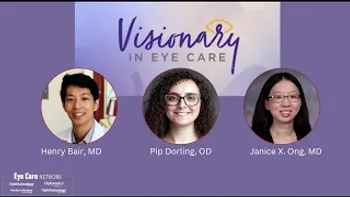
Three residents were honored for their leadership, education and research, and patient care contributions in ophthalmology, optometry, and retina.
Advertisement
Advertisement
Trending on Optometry Times - Clinical News & Expert Optometrist Insights
1
Johnson & Johnson Acuvue Oasys lenses demonstrate favorable moisture retention
2
AAOpt 2026: CLI releases full contact lens profitability report
3
EyeCon 2026: Jade Coats, OD, FAAO, on dry eye disease comorbidities
4
What retinal imaging reveals about the brain-eye connection with Sharon Fekrat, MD, FACS, FASRS
5