
Three residents were honored for their leadership, education and research, and patient care contributions in ophthalmology, optometry, and retina.
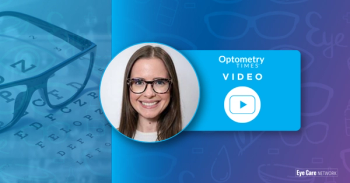
Jacqueline Theis, OD, FAAO, gave tips to clinicians on how to critically read studies in order to assess if they are applicable to their everyday practice.
Jacqueline Theis, OD, FAAO, discussed the importance of evidence-based optometry and critical appraisal of research. Her clinical work focuses on patients with brain injury and neurologic visual disorders, and she also serves on the American Optometric Association’s evidence-based optometry (EBO) group, helping to write clinical practice guidelines. This dual role has highlighted for her how essential it is for clinicians to understand not just research findings but the quality and applicability of the underlying evidence.
She described a myth-busting lecture she co-presented with Andrew S. Morgenstern, OD, FAAO, FNAP, during AOA’s Optometry’s Meeting 2026 that centers on the hierarchy of evidence, contrasting small case series—often clinically interesting but methodologically weak and prone to selection and recall bias—with randomized controlled trials (RCTs) at the top of the evidence pyramid. However, she stressed that even RCTs can have limited clinical relevance when their inclusion criteria are so narrow that they exclude the types of patients seen in many real-world practices. Clinicians must therefore distinguish between statistical significance and clinical significance, using concepts like p values and confidence intervals to judge both reliability and practical impact. An example she gives is a “35% increase” in a parameter that, in absolute terms, is only a 2-micron change—well within device error and thus not clinically meaningful.
Theis outlined a systematic approach to reading studies: ignore the title and abstract initially, and go straight to the methods section to determine study design, enrollment, potential biases, and appropriateness of the statistical model. She also urges readers to consider the journal’s integrity, distinguishing rigorous peer-reviewed outlets from pay-to-publish venues.
A substantial portion of her remarks clarifies FDA terminology:
She cautioned clinicians to ask what, specifically, a device or drug is FDA cleared or approved for, and to recognize the implications of off-label use. Theis concluded by encouraging optometrists to engage with research, rely on AOA clinical practice guidelines, and adopt a consistently critical, evidence-guided mindset to ensure safe, effective, and relevant patient care.