




Glaucoma
Latest News
Advertisement
Latest Videos


CME Content








Advertisement
More News
From surgeon to mentor: Smith fuels her commitment to improving glaucoma care by training future ophthalmologists.
FYSX is the first non-pharmacological, non-surgical treatment designed to lower IOP for glaucoma patients, according to a news release.
Pathogenesis and detection of diabetic retinopathy.

When audited after completing an education training on the delivery of laser treatments found that optometrists specializing in glaucoma were competent in providing pre- and post-treatment care.
Lorraine Provencher, MD, reviews the NOVA trial which measured and validated the sensitivity of a novel VR-based wearable headset for visual field testing in glaucoma.

North Bay Eye Associates transitions from traditional bowl perimeter to portable vision diagnostic and patient engagement system.
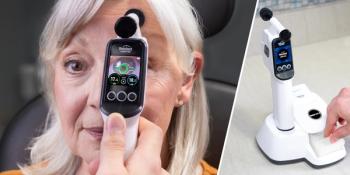
The Tono-Vera Tonometer allows for automated IOP measurements and eliminates the need for a topical anesthetic.

Nazlee Zebardast, MD, MSc, overviews her 2 presentations from ARVO 2024 that utilized polygenic risk scores to identify patients' genetic risk of developing low risk for different glaucoma subtypes.

Michael Chaglasian, OD, details results from a study that assessed the new Monaco OCT's efficacy in glaucoma detection alongside ultra wideview imaging.
Osamah Saeedi, MD, MS, details his ARVO 2024 presentation and the study finding's implications on monitoring and treating glaucoma.
Melissa Tawa, OD, FAAO, chats about glaucoma case studies, surgical interventions, and appropriate technology choices based on patients at the 18th Annual Controversies in Modern Eye Care meeting.
Deborah Ristvedt, DO, details her CIME 2024 presentation on new glaucoma management options, led alongside Inder Paul Singh, MD, Arsham Sheybani, MD, and Melissa Tawa, OD, FAAO.
At-home devices challenge commonly held beliefs on IOP measurements, visual field testing, and imaging.

The AI-powered model works to detect early signs of glaucoma and makes iHealthScreen the first company to receive 2 US patents for AMD and glaucoma screening devices.

UPFs include fast food, energy drinks and soda, sweets such as chocolates and candies, and much more.

The trials will include patients with ocular hypertension, and assess QLS-111 in its efficacy for lowering IOP beyond levels currently achievable by targeting EVP.

The clinical stage medical technology company is developing a laser system that performs femtosecond laser image-guided high-precision trabeculomtomy, or FLigHT.

Peer and public reviews for Care of the Patient with Primary Open-Angle Glaucoma will be taken until April 24.
Professor and chief of low vision rehabilitation service Patrick D. Yoshinaga, OD, MPH, FAAO, chats with Dr Korik about assistive tech, AI, and accessibility for patients with low vision.

LL-BMT1 is a novel, preservative-free, weekly drug-eluting contact lens created by the company’s proprietary 3D printing technology.
Switching produced an additional 25% IOP reduction in mild-to-moderate OAG and OHT.

Findings from Mass Eye and Ear’s collaborative study provides new insights regarding gene expression and post-transcriptional gene regulation.
Oluwatosin U Smith, MD, urges consideration of the interaction between corneal and glaucomatous disease whenever treating glaucoma or corneal issues during the annual Glaucoma 360 meeting in San Francisco, California.
Optometry Times chats with Michael Chaglasian, OD, FAAO during this year's Glaucoma 360 meeting in San Francisco, California.
Pairing the patient with the right therapy can yield dramatic results.
Advertisement
Advertisement
Trending on Optometry Times - Clinical News & Expert Optometrist Insights
1
EyeCon 2026: ODs and MDs pull up a chair
2
CVI affects "everything," so why is it still missed so often?: A Q&A with Dr Christine Roman-Lantzy
3
The Independent Advantage S02 E03: Utilizing AI for efficiency in staff workflow
4