


Patient Care
Latest News
Advertisement
Latest Videos

CME Content













Advertisement
More News
Janis Winters, OD, FAAO, shares insights from her case study that she copresented during the 2023 AOA Optometry's Meeting in Washington, DC.

Studies suggest that high glycemic load carbohydrate diets may alter the genetic influence of growth of the sclera and choroid, which ultimately can induce permanent changes in the development and progression of myopia.
Mohammad Rafieetary, OD, FAAO, shares brief highlights from his 2023 AOA presentation, "AMD updates: Staying current with its landscape," which he co-presented with Jay Haynie, OD, FAAO.
Carl Garbus, OD, FAAO, shares insights from his discussion that he copresented during the 2023 AOA Optometry's Meeting in Washington, DC.
Jacqueline Theis, OD, FAAO, shares insights from her AOA 2023 presentation on treating neurologic dry eye.
Mohammad Rafieetary, OD, FAAO, shares brief highlights from his 2023 AOA presentation, "Do you practice Eyechiatry? The psychology of vision loss," which he co-presented with Roya Attar, OD, MBA.

This 3-pronged approach for nutritional intervention to help maintain dry eye disease is in addition to a recommended dietary intake of daily oily fish.

Narcotic analgesics have a role in primary eye care, however physicians must be aware of the responsibilities associated with narcotic use.

Optometrists should be aware of the consequences of digital device use beyond myopia.

The organization aims to educate viewers of dangers and safety precautions ahead of the eclipses.

Prevent Blindness is embarking on a new strategy to raise awareness and provide education to patients and professionals to work together to address and improve the mental wellbeing for those with vision impairment.
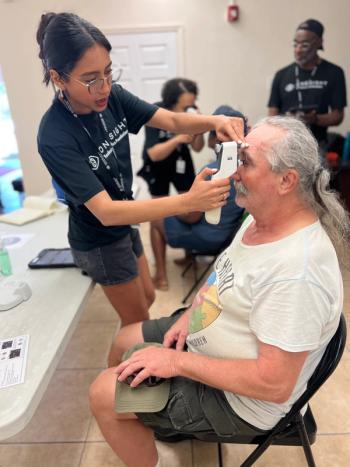
The clinic, connected with Transitions Academy, aims to address the unmet needs of more than 80 local Pathlight HOME clients who may have otherwise lacked access to eye exams and glasses.
Comanagement optimizes outcomes for patients who wear scleral lenses.

Provide better, more cohesive patient care with comanagement.

Artificial intelligence is the future of optometric disease monitoring.

Both are critical to successful treatment, but how can optometrists help?

Comfortable technologies, easier fits, and attractive features enable patients older than 45 years to stay in contact lenses.

A holistic approach provides better eye care for patients.

New research suggests sleep is an additional risk factor affecting myopia onset and progression.
Laura Periman, MD, breaks down some myths and controversies in the cosmetic world in her presentation, "Ocular toxins everywhere and in everything," presented at the Controversies in Modern Eye Care meeting.
David S. Boyer, MD, shares highlights from the symposium on advances in the geographic atrophy space, which he presented during the 17th annual Controversies in Modern Eye Care meeting.
Leo Semes, OD, shares highlights from his presentation on early detection of AMD, which he presented during the 17th annual Controversies in Modern Eye Care.
David Liao, MD, shares highlights from his discussion on evolving treatment strategies for neovascular AMD and DME, during the 17th annual Controversies in Modern Eye Care meeting.

In a sham device-controlled, randomized, double-blind clinical trial in China, researchers utilized a device that emits 650 nm red light directly to the retina.

Although the 20-20-20 rule is still a solid recommendation, recent studies have provided practitioners with more specific recommendations to help potentially prevent the onset and slow the progression of myopia.
Advertisement
Advertisement
Trending on Optometry Times - Clinical News & Expert Optometrist Insights
1
AAOpt 2026: Current controversies in macular hole diagnosis, management
2
FDA approves phentolamine ophthalmic solution 0.75% (Ryzumvi) for presbyopia
3
FDA approves subcutaneous Enspryng for TED
4
2026 Nobel Prize in Physiology or Medicine awarded for optogenetics discovery
5