
Young explores the complex relationship between recreational drug use and eye health, highlighting addiction's impact on vision and patient care strategies.
Young explores the complex relationship between recreational drug use and eye health, highlighting addiction's impact on vision and patient care strategies.
Erin Rueff, OD, PhD, FAAO, details the best ways to stay up to date with dry eye developments and innovations.
Giovanna Olivares, OD, presented 2 posters on new data concerning the Acuvue Oasys Max 1-Day for Astigmatism contact lenses at the conference.
Contact Lens Institute (CLI) Visionary Shelby Brogdon, OD, breaks down recent CLI research and what it means for patient education and care.

Justin Schweitzer, OD, FAAO, details his presentation on dry eye innovations at the conference.
Raman Bhakhri, OD, FAAO, states that even if the statistics are normally against the chance of a life-threatening condition, the margins for error are slim.

Panelists discuss how cenegermin has opened the door for other companies to research neurotrophic keratitis (NK) treatments, with emerging therapies such as topical insulin and lacrimal gland injections showing promise.
Julie Rodman, OD, MS, FAAO, highlighted the critical role of advanced imaging technologies in eye care practices during an AAOpt 2025 presentation.
Raman Bhakhri, OD, FAAO, gives tips for identifying the root cause of optic neuritis.
Rueff, OD, PhD, FAAO, stated during her presentation that optometrists are not taking full advantage of their opportunities to suggest contact lenses to their patients with presbyopia.
Coats highlighted early patient education, simulation strategies, and optometry–ophthalmology collaboration during a session on toric lenses.
Jeffrey Walline, OD, PhD, said that the growing amount of CE sessions available is what sets the annual Academy meeting apart from other conferences.
Smith highlights advances in interventional glaucoma, including first-line SLT, emerging surgical options, and comanagement strategies, during the Ophthalmology Times and Optometry Times EyeCon 2025 conference.

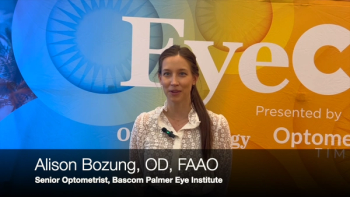
Thomas A. Albini, MD; Rahul Tonk, MD, MBA; Alison Bozung, OD, FAAO; and Joseph Allen, OD, FAAO, Dipl ABO, weigh in on what they gained from the conference.
Panelists discuss how the key to successful neurotrophic keratitis (NK) management lies in thinking about the condition when reviewing patient history and making corneal sensitivity testing a routine part of ocular surface examinations.
Panelists discuss how they educate patients about neurotrophic keratitis (NK) using analogies such as "cut phone lines" to explain nerve damage and prepare patients for the 8-week treatment process and potential adverse effects.
Mark Bullimore, PhD, MCOptom, FAAO, like other ODs, is anxiously awaiting further clinical trial results.
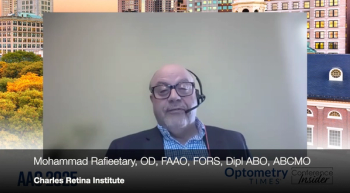
Rafieetary, OD, FAAO, FORS, Dipl ABO, ABCMO, will be joined by a handful of colleagues to discuss the latest in retina in Boston, Massachusetts, from October 8 to 11.
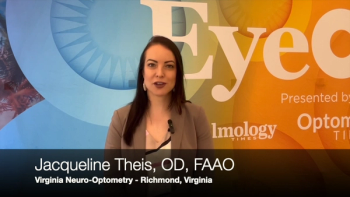
Theis outlined her “rule of 3” for evaluating urgent neuro-ophthalmic cases and discussed how retinal findings can reveal early neurodegenerative changes.
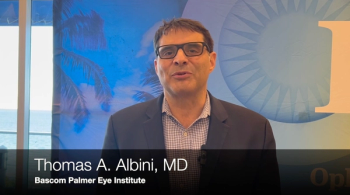
Thomas Albini, MD, shares his insights about common cases and the triaging process for patients with ocular trauma.
Mark Bullimore, MCOptom, PhD, FAAO, gave a presentation on myopia management alongside Vishakha Thakrar, OD, FAAO, FSLS, at the conference.
Rahul Tonk, MD, MBA, outlines a session he gave alongside Joseph Allen, OD, FAAO, Dipl ABO, at EyeCon 2025.
Allen discussed therapies such as perfluorohexyloctane and amniotic membrane use, stressing the importance of timely treatment and coordinated patient management.
Panelists discuss how they monitor healed patients with supportive ocular surface treatments, close follow-up schedules, and patient education about recognizing early recurrence symptoms.
Panelists discuss how they treat patients with neurotrophic keratitis (NK) with comorbidities by coordinating with glaucoma specialists, minimizing preservatives, and temporarily discontinuing contact lens wear during treatment.

Diana Canto-Sims, OD, did the digging on private label eyewear companies so you don't have to.
Panelists discuss how cenegermin-bkbj has become their first-line therapy due to its effectiveness, accessibility, and durability, fundamentally changing their approach to dry eye treatment.
Panelists discuss how their treatment approach progresses from amniotic membranes for mild cases to cenegermin-bkbj for more advanced stages, with serum tears used for maintenance therapy.
Panelists discuss how they use staging systems, such as the Mackie classification (mild, moderate, severe), and incorporate corneal sensitivity testing into comprehensive eye exams for better risk stratification.