






Myopia
Latest News
Advertisement
Latest Videos








CME Content













Advertisement
More News

R Tracy Williams, OD, FAAO, reflects on his favorite stories working as a team optometrist for the Chicago Bulls and Chicago White Sox in the last 20 years.


The prevailing message is that physicians have “a long way to go” in the optimization of management and prevention of myopic vitreoretinal disease.

Diffusion Optics Technology (DOT) spectacle lenses are intended to slow myopia progression in children via contrast management mechanism of action.

Myopia management in children is a crucial step to ensuring the overall health and wellness of our youth.

A new study out of Guangzhou, China found that individuals younger than 18 years of age and experiencing high myopia are at a high risk of progressively worsening myopic maculopathy.

The report, released by the American Optometric Association and the Deloitte Economics Institute, illustrates the significant impact that screens have made in the workplace, and why it’s important that eye care providers help ease its cost.

The event collaborates with a number of local Latin American organizations and will be held entirely in Spanish in a continued effort to combat myopia on a global scale.

Robert Weiss, former president and CEO of The Cooper Companies, shares some of the latest optometric schooling developments from Vietnam in his work with Optometry Giving Sight, the Brian Holden Foundation, and Hanoi Medical University.

The TENEO excimer laser platform is intended for use for LASIK vision correction surgery for myopia and myopic astigmatism.

A research report compiled by The Vision Council reveals that most parents are aware of myopia but remain in the dark about prevalence and how to prevent progression.

The multidisciplinary program aims to bring myopia management tools to under-resourced children across the US.

Mark Bullimore, MCOptom, PhD, FAAO, discussed myopia control in a panel at EyeCon 2023, highlighting evidence-based treatments, myopia's impact on visual impairment, and a multidisciplinary conversation involving optometrists and ophthalmologists to address the growing issue of myopia management.

Kelly K. Nichols, OD, MPH, PhD, FAAO, and A. Paul Chous, OD, FAAO, recap the diverse topics at EyeCon 2023, emphasizing the collaborative spirit between optometrists and ophthalmologists in addressing issues such as myopia management, diabetic eye conditions, cataract surgery, and patient referrals.

Myopia as a glaucoma risk factor, and high myopia as a potential glaucoma mimicker, can be quite the clinical headache

Research presented during the 2023 American Academy of Optometry meeting highlighted the importance of myopia management techniques to control and slow the progression of myopia.

The American Academy of Orthokeratology & Myopia Control-hosted conference was held September 5-9.

AAOMC is focusing on new membership growth, diversity, and how they can continue to move the needle in myopia management.

Making the most of multifocal contact lenses in your practice.

This new platform incorporates the SILK procedure, allowing surgeons to perform refractive correction on patients with myopia.

Research into multiple aspects of myopia control warranted.

In this part 2 of the pediatric myopia and keratoconus series, Drs Chan and Swartz dive into ortho-k and crosslinking in children.
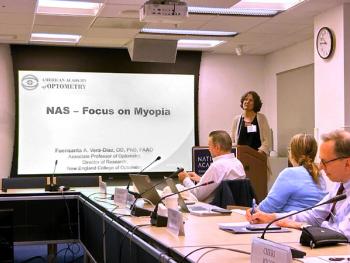
Fuensanta A. Vera-Diaz, OD, PhD, FAAO, Director of Research and Associate Professor of Optometry at the New England College of Optometry (NECO) repersented AAO at the first meeting of the Committee on Focus on Myopia.

Johnson & Johnson Vision’s ACUVUE Abiliti brand announces its back-to-school campaign to inform parents about myopia and the growing risk of the disease

Pediatric keratoconus is often more challenging to diagnose, resulting in treatment delay and vision loss.
Advertisement
Advertisement
Trending on Optometry Times - Clinical News & Expert Optometrist Insights
1
BIM-IOL System holds 37% IOP reduction at 4 years in first-in-human trial
2
Takeaways from this week in optometry: October 16-23
3
Brepocitinib for noninfectious uveitis meets all phase 3 trial end points
4
More than monitoring: Using AMD visits to promote healthy vision aging
5