

News


All series


All News

Contact lenses are a large part of any general eye care practice. It is one source of great pride and satisfaction when a patient new to contact lenses first sees clearly without his spectacles, and we all enjoy seeing that epiphany. Yet, like with all experiences, the new soon wears off, and those patients who started out with the best of intentions regarding their contact lens wear and care can slip into some not-so-healthy habits.
What are some common questions our patients expect to hear from us? “How is your vision? Which is better, one or two? How many nights out of the average month do you sleep in your contact lenses?” Sure, these are the easy answers, but when is the last time you surprised your patient with a question about their diet?

Why has Demodex gone viral?

Although the Demodex mite is not a recent discovery, you might not realize that by the rapid rise of demodex in the ophthalmic professional sphere. From peer-reviewed journal articles to lectures at professional meetings to chatter on the exhibit hall floor to thought-leader informational videos, Demodex has been a popular topic for the past 12-18 months.

Next month in Boston, the American Society of Refractive Surgery (ASCRS) will host optometrists its second Integrated Ophthalmic Managed Delivery Model (IOMED) track at the group’s annual meeting. The format will be similar to last year’s meeting with a half-day symposium as well as courses that will be available for optometrists to earn CE credit.

I readily admit I am from another time, before cell phones and laptops. But not video games. I wore Pong out back in the day. Still, I think I have adapted reasonably well as an old curmudgeon to the available technology.

The U.S. Food and Drug Administration (FDA) has asked healthcare professionals to stop prescribing combination prescription pain relievers that contain more than 325 mg of acetaminophen per tablet, capsule, or other dosage unit, citing the risk for liver damage.

The New Jersey State Legislature recently passed a bill that will require the New Jersey Department of Education to develop an educational fact sheet for parents concerning sports-related eye injuries.

Volk Optical recently introduced the Pictor Plus, a handheld ophthalmic camera that can provide high-resolution images of the retinal and anterior segment at off-site clinics or during field work.

OD Q&A: Matt Geller, OD

We give [students] the issues of what's going on in the profession but not to a degree where they're going to become overwhelmed. We try to cover an issue with a proactive and positive voice.

Except for a 6-month stint at an optical more than 20 years ago, I haven’t spent much time in that part of the industry. It’s time I did. Plus, we’re going to step up coverage in our pages and online presence as well. I hope you’ve already noticed the new look of our InDispensable news and product section.

The power of recommendation

There is significant healing power in the doctor-patient relationship. If we work together in these relationships, significant improvement can occur to our patient’s quality of life and health status.

We are all seeing an increasing number of presbyopes in our practices, as the baby boomer population bubble enters that stage of life where wisdom causes the loss of focus. There are many challenges we as doctors need to address within this population, including contact lens wear.

Otolaryngologists (ENTs) have it easy. They can instruct their patients not to stick anything in their ears that is smaller than their elbows, and not only is it sound medical advice, but it has a fairly high rate of compliance. Eyecare professionals (ECPs) who fit contact lenses, on the other hand, have a more difficult hill to climb because we purposely put materials in our patients’ eyes, an impossible feat without biocompatible products.

At the heart of every optometric dispensary lies the important job of managing the frame board inventory. This task can appear to be challenging at times, but by following some simple strategies, it will lead to success.

Comanaging with confidence

The end game of any comanagement arrangement is providing patients with the best possible care they can receive. This seemingly obvious conclusion is sometimes clouded by the perception that optometry and ophthalmology are not working in tandem, and patients may be left confused and unsure about what is the best option for their ophthalmic care.

The majority of employees are regularly affected by at least one visual disturbance at work that could diminish their performance, with most taking multiple breaks during the day to rest their eyes, according to new research sponsored by Transitions Optical, Inc.

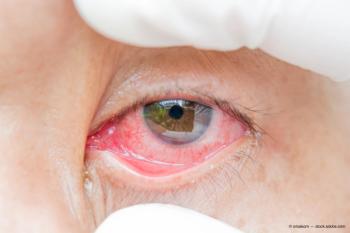
Adenoviral conjunctivitis (Ad-CS) has never been so popular a topic as it is right now. With over 26 million viewers tuning in to watch the Olympics, Americans have watched Bob Costas’s unilateral conjunctivitis worsen, then become bilateral. His ocular condition prompted many commentators to remark, “Can’t someone help him?”

A few months ago, I began to see what may be a little more progression on her OCT studies. I’m fairly confident that we’re in a good place right now as far as compliance is concerned, and I’m entering a crossroads with her regarding possibly adding therapy vs. getting a consult for a laser procedure, such as selective laser trabeculoplasty (SLT), vs. getting a cataract consult.

With the advent of advanced anterior segment imaging, we as optometrists are tasked with the responsibility of going beyond knowing the basics of the eye’s anatomy.

I was fortunate to attend last week’s launch event for Bausch & Lomb’s new silicone hydrogel contact lens, Ultra. This unique entry into the silicone hydrogel line contains a formulation of three silicone molecules combined with a high PVP content and manufactured using MoistureSeal technology, yielding a contact lens with high oxygen transmissibility and low modulus.