



News


All series


All News

The pediatric eye exam differs greatly from the adult eye exam-children are more than just tiny adults. To further that point, the whole dynamic of the exam is different because you are really interviewing and interacting with the family and not just the patient. In the pediatric arena, the family becomes your patient.

Researchers at Columbia University Medical Center recently discovered a gene that causes myopia in people who spend a lot of time reading or doing other “nearwork” throughout their childhood. The study was published in PLOS Genetics.

The lipid layer prevents evaporation of aqueous tears and prevents drying. Lipid deficiency due to meibomian gland dysfunction (MGD) is the most common cause of symptoms associated with dry eye disease.

Essilor recently announced it had acquired independent optometric service alliance Vision Source, raising questions about the future for thousands of Vision Source members and Essilor customers across the country.

A recent editorial in The Journal of the American Medical Association (JAMA) raised some questions about the indications for medical marijuana, which vary greatly by state.

It takes a lot to impress us as optometrists these days. Most of us enjoy a prestigious professional career with a flexible working schedule and a very satisfying personal life. So, why was I so impressed with a recent contact lens training seminar? Let me walk you through my virtual diary to share my personal impressions on this recent training.

Allergan recently issued a voluntary U.S. recall of its Refresh Lacri-Lube, Refresh P.M., FML (fluorometholone ophthalmic ointment) 0.1%, and Blephamide (sulfacetamide sodium and prednisolone acetate ophthalmic ointment) 10%/0.2% due to customer complaints of small black particles at the time of use.

We recently brought you a list of the states where optometrists make the most money-and where they make the least. We wanted to break it down even further and see which big cities and small towns offered high-paying opportunities to ODs, according to the Bureau of Labor Statistics.

After more than a decade of working in a MD/OD private practice, I found myself at a crossroads in my career. I spent this past year exploring many modes of practice to find the best fit for my next decade-or two or three.

Congressman Earl “Buddy” Carter (R-GA) recently introduced a new bill titled “Dental and Optometric Care Access Act (DOC Access Act)” that would address conflicts between dentists and eyecare providers and insurance providers.

OD Q&A: Barbara Horn, OD

My brother when he was a child, the oldest, got to have vision therapy at a little optometrist’s office. My mother and I would sit there and watch him go through his therapy, and I always thought it looked like so much fun. So, watching him I was jealous that he got to do it, and I didn’t.

Treating the aging eye

In the aging eye, accommodation decreases; the crystalline lens yellows, hardens, and eventually opacifies; and systemic diseases such as arthritis, thyroid disease, cancer, diabetes, atherosclerosis, and high blood pressure take their toll on the eye. In addition, cognitive and functional limitations affect the aged.

At present we are limited with our ability to treat presbyopes. Sure, we have progressives and multifocal contact lenses; however, from a surgical standpoint, monovision corneal refractive surgery is limited, and clear lens extraction is often extreme for emmetropes.

Focusing on dry eye management is a great practice builder, but is not without challenges. These challenges lie in making the proper diagnosis, implementing new technology, properly training staff, developing an effective treatment plan and the time it takes to properly educate patients.

Warm compresses (WCs) are commonly recommended as supplementary therapy for MGD as well as a number of other conditions of the eyelid. While the core therapy for MGD is to remove obstruction, which requires an in-office procedure, the therapeutic goal of adjunctive WC use is to heat the eyelids to help soften and partially melt any remaining material obstructing the glands.

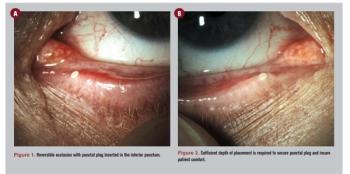
How often are you using punctal plugs in your practice? If your answer is similar to mine, it’s “not as often as I used to.” Classically, punctal plugs were a go-to treatment for dry eye patients. If artificial tears failed to yield relief, plugs were a logical next choice.

The power of and

Many of our patients have become accustomed to the usual and customary. Most patients know what to expect when they arrive for their annual eye exam. It’s time we think about upping our game with the use of “and.”

With that in mind, there are several aspects of my own EHR software that I really appreciate over paper charts. Besides the fact that I can actually read what I wrote (or typed), one thing that I particularly enjoy is the fact that I am able to consistently look at a new patient’s optic nerves without knowing his or her intraocular pressure (IOP) values beforehand.

Two weeks ago the optometric profession heard the shocking news that Professor Brien Holden, PhD, DSc, OAM, had passed away suddenly. Brien was larger than life, and I’m sure I wasn’t alone in thinking that such an event wouldn’t be happening any time soon. Sadly, we were wrong.

It would be easy to get into a routine of one and two, and one and two, and on and on until everyone looks the same. But for me, everyday joy lies in the little conversations I get to have in between their prescription and eye healthcare conversations with those who entrust their care to me.



